Queen Creek water is hard. It comes out of the tap heavy with calcium, it leaves a white line on the tile, and it pushes pH upward week after week. Balancing a pool here is a different job than balancing one filled from softer water, and it is the job Tartan Pools does on every weekly visit from our office on S 187th Place.
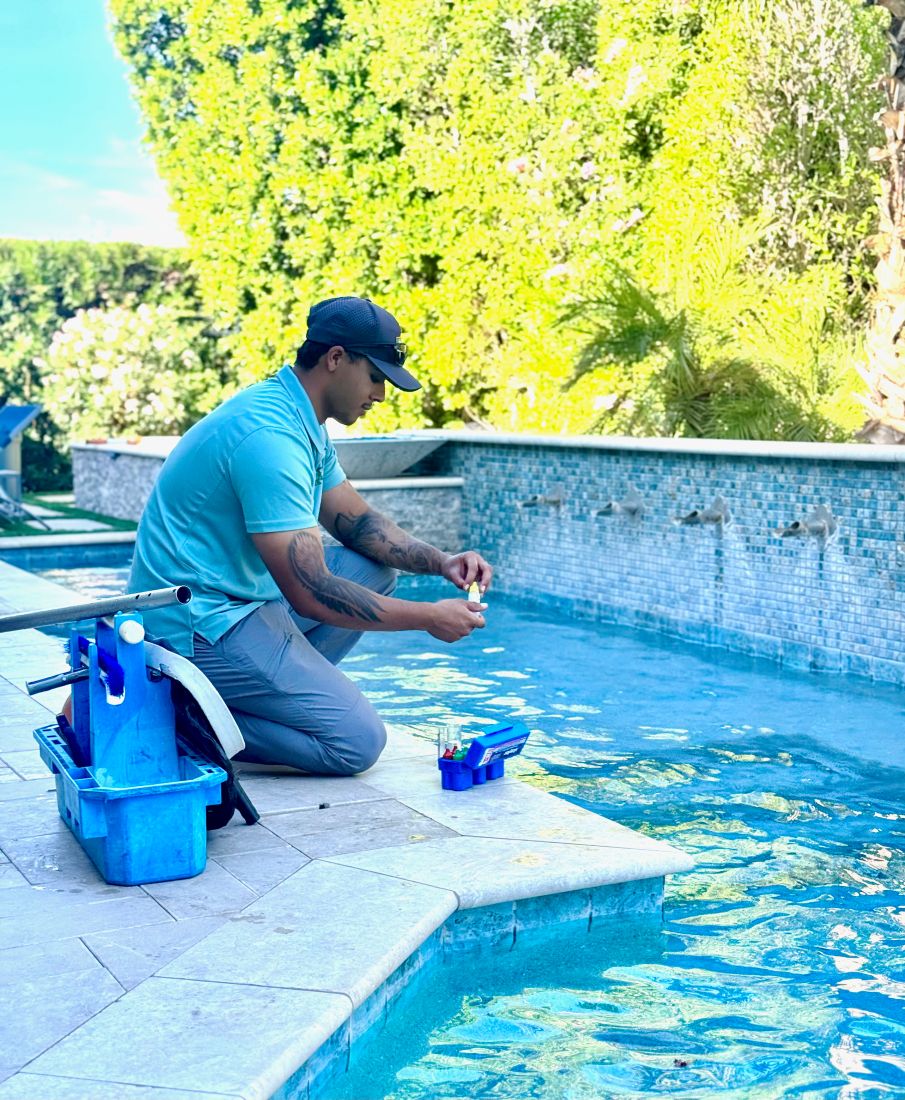
We test on site, add exactly what the water needs that day, log the readings in your online portal, and show them in the photo report you receive before the technician leaves. If you would rather not think about chemical costs at all, our chems-included plan starts at $179 per month.
✔ Calcium hardness climbs - every top-off adds calcium, and in summer you top off constantly. Left alone it ends up as scale on tile, pebble and the salt cell.
✔ pH drifts up - hard water, aeration from water features and salt chlorine generators all push pH higher. High pH makes chlorine lazy and makes scale faster.
✔ Evaporation concentrates everything - at 105 to 115 degrees the water leaves and the dissolved solids stay. Stabilizer, calcium and salt readings all creep upward through the summer.
✔ Dust raises chlorine demand - monsoon debris from the surrounding farmland and desert feeds algae and eats sanitizer from July through September.
✔ Free chlorine - dosed for the week ahead based on the heat, the bather load and how much dust is in the air, not a fixed amount.
✔ pH - corrected downward on most Queen Creek pools most weeks. The readings are logged so you can see the trend.
✔ Total alkalinity - held in a range that buffers pH without encouraging scale, which is a narrower window here than in soft-water areas.
✔ Calcium hardness - tracked closely. When it climbs past what balancing can manage, we tell you plainly that a partial drain is the fix, rather than selling more chemical.
✔ Cyanuric acid - stabilizer protects chlorine from the sun, but too much of it, built up over a summer of tabs, stops chlorine from working. We watch for it.
✔ Salt level and cell output - on salt pools, we verify salt with a real test, not just the controller display, and inspect the cell for scale.
Much of what we service in Cortina, Crimson Heights, La Sentiero and the newer streets of Hastings Farms is recently built: pebble finishes, salt chlorine generators and variable-speed pumps. A new pebble finish is sensitive to chemistry in its first year, and hard water will scale it quickly if calcium and pH are allowed to run high together. Salt cells scale the same way. Keeping both readings in range is the single most useful thing a weekly technician does for a new pool in Queen Creek.
HOA neighborhoods such as Montelena, Sossaman Estates and The Pecans add one more reason to stay balanced: a pool that turns cloudy where neighbors can see it tends to generate a letter. Logged readings and a weekly photo report are a simple way to show the pool is being looked after.
Chemicals fix chemistry, not everything. If the pool is already green, it needs a green-to-clean first. If calcium hardness or stabilizer has climbed beyond what adjustment can bring back, a partial drain costs less than fighting it. If a filter is packed with monsoon dust, no amount of chlorine will clear the water until the filter is cleaned. Our technicians tell you which of these you are dealing with, and they do not add chemical to a pool that needs something else.
Weekly service, from $140 per month plus chemicals, by pool size. Testing and balancing are part of every visit.
Chems-included plan, from $179 per month. Routine chemicals folded into one flat price.
One-time correction. Quoted from your readings or a photo; confirmed before we start.
See the specials page for current first-month offers, and the Queen Creek pool service page for the rest of what we do in town, including equipment maintenance.
Call (480) 999-9226 or text us your last readings and we will tell you what Queen Creek water is doing to your pool. Office hours are 24 hours a day, 7 days a week. We balance pools across Queen Creek, Ironwood Crossing and Encanterra in San Tan Valley, and Gilbert, Mesa, Chandler and Tempe, and we are rated 4.9 on Google.

Cloudy water, eye-burning chlorine smell, a pH that will not stay down or a salt system that says low salt when the salt is fine: text us what you are seeing and, if you have them, your last test readings. We will tell you what is going on in Queen Creek water and what it will take to fix it.

Get a Free Quote
Hard, calcium-heavy fill water and constant top-offs through summer push pH up, and salt chlorine generators push it up further. We correct pH weekly, keep alkalinity in a range that stops the swings, and manage calcium hardness so the rising pH does not turn into tile scale.
Yes. Calcium plates onto the salt cell, output drops and the controller may show false low-salt warnings. Balanced calcium and pH slow the scaling, and the cell is inspected on the route so it can be cleaned before chlorine production falls.
For most Queen Creek pools, yes. Summer evaporation at 105 to 115 degrees concentrates what is in the water, chlorine burns off fast, and dust raises demand. The chems-included plan starts at $179 per month and takes the whole question off your plate.
Every weekly visit, on site, with the readings logged in your portal and shown in the photo report. Testing once a month, or when the water looks off, is too late in a Queen Creek summer.